Roof Replacement
Full re-roofing for mountain homes: weatherboard cottages, Federation houses and steep-pitch builds, each specified for the climate it sits in.
Learn more →Leaks, slipped tiles, failed flashings and crumbled ridge pointing repaired across the Blue Mountains. Free inspection. Call (02) 4703 5000.
Full re-roofing for mountain homes: weatherboard cottages, Federation houses and steep-pitch builds, each specified for the climate it sits in.
Learn more →Colorbond roofing across the mountains, with non-combustible detailing for homes on bushfire-prone land.
Learn more →Restoration suits mountain tile roofs better than most: stripping moss and lichen, rebedding ridges and recoating so the roof sheds water again.
Learn more →Gutter replacement and ember guard for Blue Mountains properties, where leaf litter and ember entry are the same problem.
Learn more →Emergency response across the mountains after heavy rain, hail or wind, starting with a make-safe the same day.
Learn more →Roof inspections and written reports for mountain homes, including pre-purchase checks and insurance documentation.
Learn more →Most calls start with one of four things: a brown ring on the ceiling, a drip into a bucket, a tile lying on the lawn, or grey mortar crumbs in the gutter that turn out to be what is left of the ridge pointing. Any of those is worth a look now rather than after the next wet week.
Up here the gap between a small leak and an expensive one is short, because roofs stay wet. A coastal roof dries in an afternoon. A shaded roof at Hazelbrook or Leura under canopy can stay damp for days, so timber that gets wet stays wet, and the fault spreads into battens and ceiling linings.
Ring (02) 4703 5000 and we will come out, get on the roof and tell you what is going on. Inspection and written quote are free, and there is no obligation at the end of it.
The most common fault in the upper mountains and the one most often misdiagnosed as "a cracked tile". Water soaks into the bedding mortar, freezes overnight, expands, and breaks the mortar apart from the inside out. Do that enough winters and the pointing goes to powder, the caps start to rock, and rain enters at the highest line on the roof and runs the length of the framing before it appears anywhere visible. The fix is to rebed the caps and repoint with a flexible compound that tolerates movement, not a rigid sand-and-cement mix.
Valley irons collect every leaf and strip of bark the gums drop. Litter dams the valley, water backs up sideways under the tiles, and the valley board underneath quietly rots. On older homes around Springwood and Woodford the valley iron itself is often corroded through under the debris.
The Federation and inter-war stock through Katoomba, Leura and Mount Victoria carries a lot of brick and sandstone chimneys. Once the lead apron has lifted or the old mortar fillet has cracked, driving rain finds the gap. The same applies to skylight upstands and to the step flashings where a lower roof meets a wall.
Branch strike off a mature gum, a foot in the wrong place, or simple age. A single broken tile is cheap. A slipped tile that has been letting water onto a batten for two winters is not.
A blocked gutter in heavy rain backs water up over the tile ends and into the eaves. It is a roofing problem presenting as a gutter problem, which is why we look at both. See gutter repair and replacement if that is the main symptom.
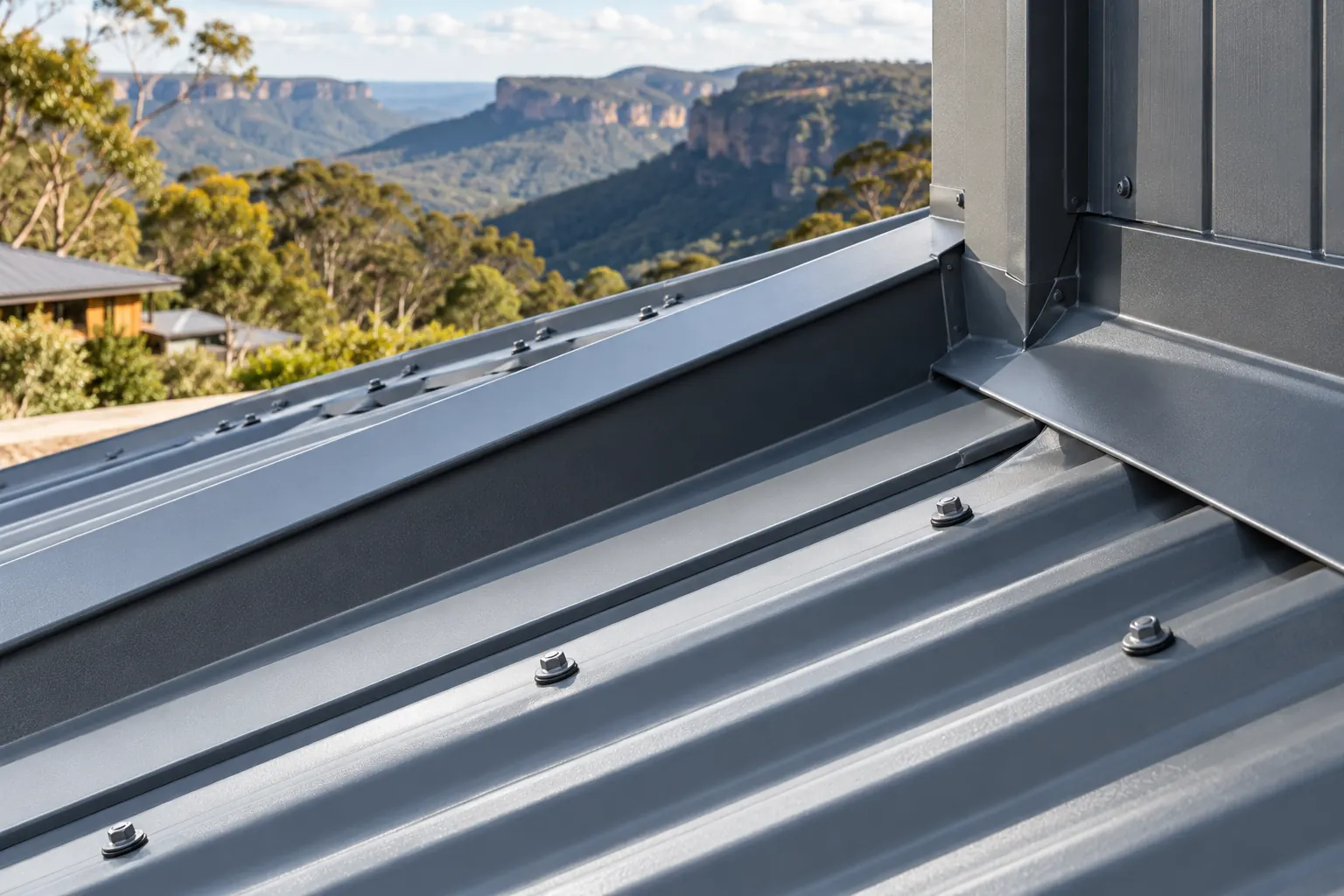
We walk the roof rather than looking at it from the ground. That means ridges and hips, valleys, every flashing and penetration, the gutter line, and where there is safe access, the ceiling space from below. Photographs of anything we find go to you with the quote, so you are not taking our word for it.
If the roof is actively leaking we will make it safe on the first visit where we can — temporary sheeting or a tarp over the opening — and book the permanent repair separately. Storm work has its own page: storm and emergency roof repairs.
Then you get a written quote with the scope itemised. Not a lump sum with no detail behind it.
Honest answer: a lot of mountains roofs that look terrible are repair or restoration jobs, not replacements. Dark staining, moss on the south pitch and a chalky faded surface look alarming but say nothing about whether the tile is sound.
A repair is the right call when the fault is localised, the battens are dry and the rest of the roof has life in it. If the pointing has gone right across every ridge and the surface coating has broken down, you are probably looking at a roof restoration instead, which does the whole roof once rather than the same ridge three times. If the structure underneath is failing, a roof replacement is the cheaper answer over ten years.
We would rather tell you which of the three it is than sell you the biggest one. If you want it on paper before you decide, a roof inspection and written report does exactly that.
We do not publish dollar figures, because a number invented before anyone has seen your roof is worthless. The quote follows the inspection.
Call (02) 4703 5000, or send the quote form with the roof type, its rough age and what you have noticed. Work is carried out by established, licensed and insured roofing contractors working to NSW Fair Trading requirements, and completed repairs carry a written workmanship warranty.
Because the leak is almost certainly at a vertical junction rather than in the field of the roof. Chimney flashings, wall abutments, skylight upstands and barge details only let water in when rain is being driven sideways onto them. In still rain the same roof stays dry. That directional pattern is useful information, so tell us which way the wind was coming from.
Sometimes, but it needs a genuine dry window. Pointing compound has to cure before it meets frost, and a cap pointed the afternoon before an overnight freeze can be compromised. Above about 900 metres we would rather do a sound temporary make-safe and repoint properly in a settled stretch than rush it. Below Springwood the window is far more forgiving.
Usually, yes. Secondhand tile yards carry a lot of the older terracotta and concrete profiles used through the mountains, and a handful of matched tiles is enough for most repairs. If nothing matches, we can often relocate sound tiles from a hidden elevation to the visible one and put the odd tiles where no one sees them.
Probably. A leak that keeps coming back in the same place generally means the cause has not been found, or the underlying element has failed rather than the surface above it. A rotted valley board, a corroded valley iron or a sagging batten will keep producing a leak no matter how many tiles get resealed. That is the point at which a proper inspection earns its money.
It helps a lot. Water can enter at a ridge and travel several metres along the framing before it shows on plaster, so the wet patch on the ceiling is rarely under the hole. Looking at the ceiling space from below, where there is safe access, tells us which rafter the water is running down and narrows the search on the roof considerably.
Tell us what you need and we'll get straight back to you. Prefer to talk? Call (02) 4703 5000 and speak to someone local.
Call (02) 4703 5000