Roof Repairs
Leak and tile repairs from Glenbrook to Mount Victoria, where moss on shaded pitches and frost-damaged pointing cause most failures.
Learn more →Colorbond and metal roofing across the Blue Mountains: profiles, fixings, condensation control and non-combustible detailing for bush blocks.
Leak and tile repairs from Glenbrook to Mount Victoria, where moss on shaded pitches and frost-damaged pointing cause most failures.
Learn more →Full re-roofing for mountain homes: weatherboard cottages, Federation houses and steep-pitch builds, each specified for the climate it sits in.
Learn more →Restoration suits mountain tile roofs better than most: stripping moss and lichen, rebedding ridges and recoating so the roof sheds water again.
Learn more →Gutter replacement and ember guard for Blue Mountains properties, where leaf litter and ember entry are the same problem.
Learn more →Emergency response across the mountains after heavy rain, hail or wind, starting with a make-safe the same day.
Learn more →Roof inspections and written reports for mountain homes, including pre-purchase checks and insurance documentation.
Learn more →Steel sheeting has three advantages that matter specifically up here, and they are physical rather than promotional.
It is light. On a steep mountain pitch, replacing a tiled covering with steel takes a significant dead load off the frame, which is useful on the older timber-framed stock through Woodford, Lawson and Mount Victoria.
It sheds. There is no mortar bedding to break down, no deep tile profile to trap eucalypt leaf and bark, and a steep steel pitch clears water, litter and settled snow far faster than tile.
It does not burn. On mapped bush fire prone land, with roughly 70% of the local government area sitting inside Blue Mountains National Park, a non-combustible covering makes the rest of the bushfire detailing simpler to get right.
Call (02) 4703 5000 and we will come out, measure up and put a written quote in front of you at no cost.
Pitch also decides things. Many mountains roofs were built steep deliberately, to throw water and leaf litter off quickly, and a steep pitch opens up the profile choice. A near-flat verandah or skillion narrows it fast.
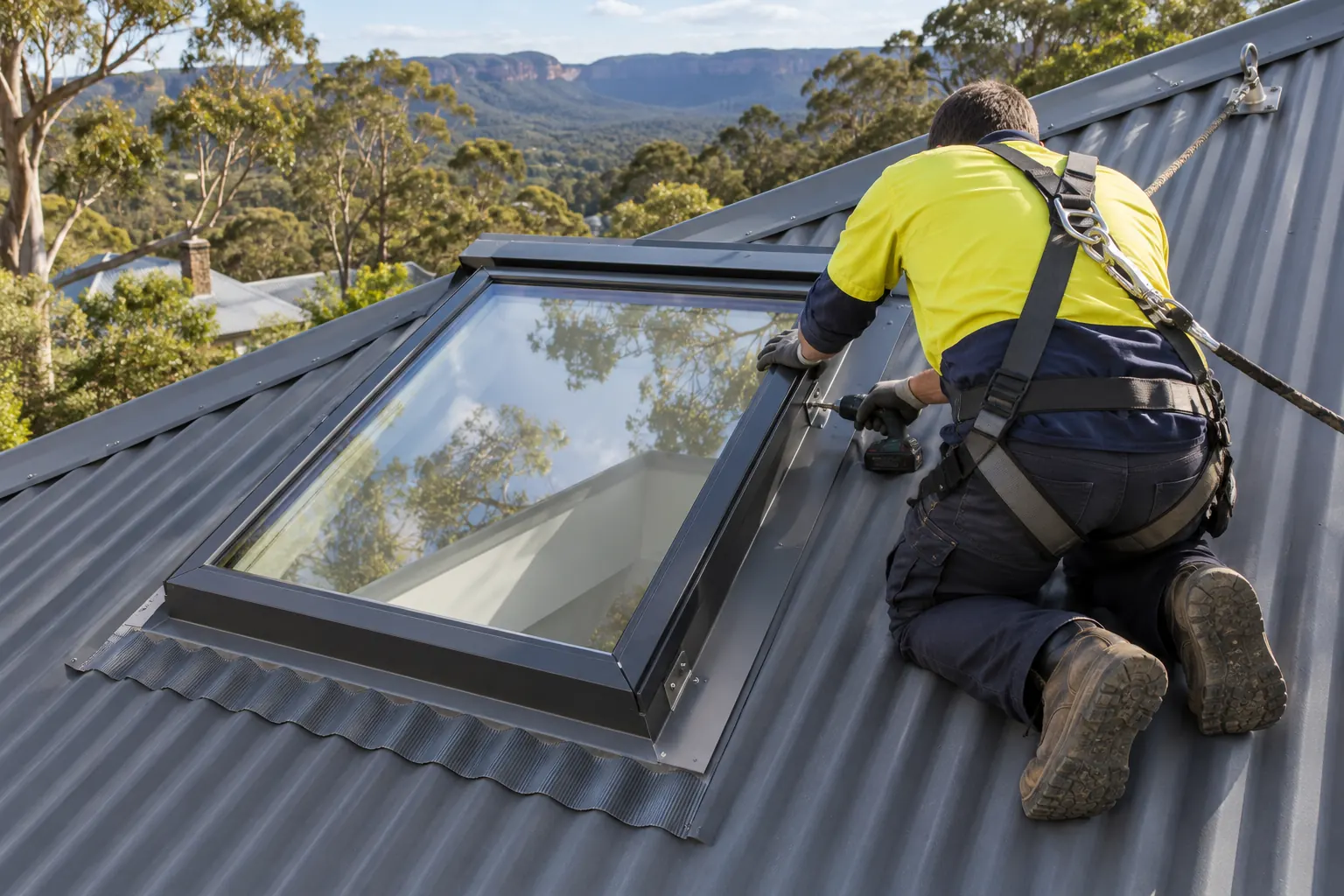
Steel moves with temperature, and the temperature swing here is larger than on the coastal plain — frost before dawn, full sun by mid-morning. Over a long run that movement is real, so fixings need to be correct type, correct spacing and driven to the right depth: too loose and the sheet works at the fastener, too tight and the washer is crushed and stops sealing.
Side laps and end laps have to face the right way for the prevailing weather, and in fog-prone locations capillary action will pull water uphill through a lap that has been laid lazily. Most of the "mystery leaks" we get called to on metal roofs are a lap, a fixing or a flashing — rarely the sheet.
This is the single most common specification failure on metal roofs above 600 metres. The sequence is simple: the interior is warm and carries moisture from showers, cooking and drying clothes; the underside of the steel is near or below freezing; moisture condenses on it and runs off onto insulation and ceiling timbers.
Homeowners report it as a leak. It is not. The fix is in the build:
Two different conversations, sometimes on the same house.
On a bush block the muted greys, greens and charcoals disappear into the canopy and stay cooler in summer than a dark gloss would, while light colours show lichen staining badly in a damp, shaded position. On a street inside one of the Katoomba or Leura conservation areas the question is different: the controls in Blue Mountains LEP 2015 and Part D of the Development Control Plan put material, profile and colour in scope, and a strong modern colour on a Federation roof will attract attention. Muted, traditional tones are both the safer planning answer and generally the better-looking one.
Where a Bushfire Attack Level applies to your property under AS 3959, the roof is one of the elements it governs. In practice that means a fully sarked roof, a sealed roof-to-wall junction, non-combustible ember guards to openings and penetrations, metal gutters, and any box gutter non-combustible and fully flashed. Note that a leaf guard and a certified ember guard are different things even where one product claims both — check what the certification actually covers.
A steel roof does not exempt you from any of that, but it starts you from a non-combustible covering, which is a better starting point than a tiled roof with open tile ends.
We will not quote sheeting laid over an existing tile roof. It traps the old covering and whatever moisture is in it, loads the frame with weight it was never designed to carry permanently, and makes any future access or repair far worse. A proper roof replacement strips to the frame so battens, sarking and insulation can be inspected and renewed.
If your existing tiled roof is sound and you simply want it to look and perform better, roof restoration is usually the cheaper and more sensible option, and we will say so.
Ring (02) 4703 5000 or send the form with your roof type, its approximate age and what you are trying to achieve. Roof area, pitch, profile choice, access and any BAL or heritage requirements are what move the price, and the quote comes after someone has been on the roof — not before. Work is carried out by established, licensed and insured roofing contractors working to NSW Fair Trading requirements, with a written workmanship warranty.
The covering itself often does, but the more useful comparison is maintenance. A tiled roof here has bedded mortar at every ridge and hip, and freeze-thaw cycling above Lawson breaks that mortar down on a cycle you will keep paying for. A steel roof has no mortar to fail. What it needs instead is sound fixings, correct laps and real condensation control, and those are build-quality questions rather than recurring costs.
Short-run corrugated, nearly always. It is the profile the original mountains building stock was roofed in, the shadow line suits a steep pitch, and it reads correctly against weatherboard, gables and finials. Wide-rib trapezoidal sheeting is efficient on a long modern span but looks wrong on a Federation roofline and tends to attract comment in a conservation area. We will tell you which one your house wants.
Because a cold steel roof over a warm, humid room sweats on its underside, and at Katoomba or Blackheath the roof is below dew point on most winter nights. That condensate drips onto insulation, timber and ceilings and gets blamed on a leak that does not exist. A sarking membrane with an absorbent anti-condensation face, plus genuine ceiling-space ventilation, stops it. It is specification, not an upsell.
Yes, if it is flashed properly. The failures we get called to are almost always the flashing rather than the unit: a soaker that was never dressed into the pans correctly, or a sealant-only detail that has hardened and cracked. On a steep mountains pitch the upstand height and the way the flashing is turned into the corrugations are what keep driving rain out. It is a detail job, not a cut-and-silicone job.
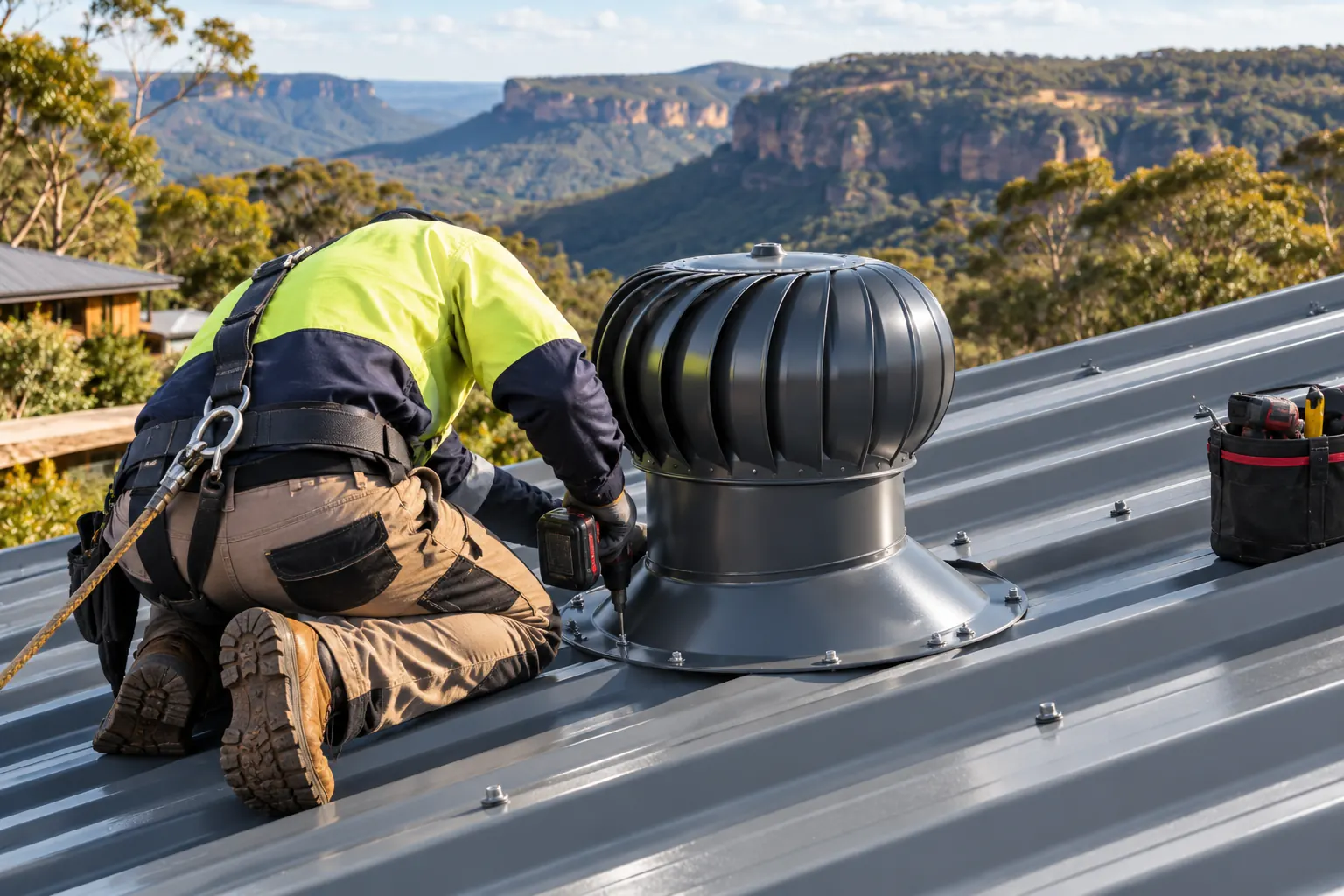
They earn their place for a different reason here than on the coast. Down on the plain people fit them to dump summer heat. In the upper mountains the real value is moving moist air out of the ceiling space through winter so it does not condense on the underside of the roof. Paired with adequate intake at the eaves, ventilation is part of keeping a cold roof dry.
Tell us what you need and we'll get straight back to you. Prefer to talk? Call (02) 4703 5000 and speak to someone local.
Call (02) 4703 5000